
- Insights
Fast Food vs. Restaurants: How Is the Foodservice Market Structured Across Europe?
The European foodservice market has undergone contrasting developments in recent years. While fast food has long been perceived as a threat to traditional restaurants, the data reveals a more nuanced reality: the two segments often follow similar trajectories, while also reflecting deeply rooted consumption habits that vary from country to country.
Overall, the period between 2019 and 2022 was favourable across most European markets, with growth in the number of establishments in both traditional restaurants and fast-food outlets. Since 2023, however, the trend has reversed in most of the countries analysed.
While this overall dynamic is relatively consistent, the balance between fast food and traditional restaurants varies significantly across Europe. We analysed seven major European markets: the Netherlands, Italy, France, the United Kingdom, Spain, Germany, and Belgium.
⭐ To better understand this analysis...
Our definition of fast food: the fast-food segment includes quick-service establishments typically offering counter service, takeaway, or delivery. This includes burger chains, kebab/shawarma outlets, takeaway pizza chains, taco outlets, snack bars, and chip shops.
Our definition of restaurants: the restaurant segment includes traditional table-service establishments, such as independent restaurants, fine dining venues, brasseries, trattorias, traditional pizzerias, and other forms of sit-down dining.
The Netherlands

The Netherlands currently has 12,603 fast-food outlets compared with 17,390 restaurants, equivalent to 1.38 restaurants for every fast-food outlet. The Dutch fast-food market is relatively well developed, driven primarily by the kebab/shawarma and snack/fries segments, which also include burgers. On the traditional restaurant side, the number of establishments has remained relatively stable despite a slowdown over the past two years, with a decline of around 2%.
Italy

Italy has 13,400 fast-food outlets compared with 91,420 restaurants, equivalent to 6.8 restaurants for every fast-food outlet. This ratio, by far the highest among the countries analysed, reflects Italian consumers’ deep-rooted attachment to their culinary heritage.
That said, the fast-food segment has experienced particularly rapid growth since 2019, reaching a peak of almost +50% in the number of outlets in 2023. Since 2025, however, the market has shown signs of slowing, with the number of fast-food outlets declining by around 2%. Traditional restaurants have followed a similar trend, with declines of 3% in 2024 and a further 2% in 2025.
France

In France, there are 29,103 fast-food outlets compared with 95,184 restaurants, representing 3.3 restaurants for every fast-food outlet. Although traditional restaurants remain dominant, France has a proportionally larger fast-food presence than Italy.
The two segments have followed very similar trajectories in recent years. Between 2019 and 2022, the number of establishments increased significantly, reaching a peak in 2021 (+15% for fast food and +10% for restaurants). Since 2023, however, the market has entered a contraction phase. It is worth noting that traditional restaurants are currently declining at almost twice the rate of fast-food outlets.
United Kingdom

In the UK, the balance is completely reversed: there are 52,854 fast-food outlets compared with 45,577 restaurants, making the United Kingdom the only country in this analysis where fast food outnumbers traditional restaurants. This equates to 0.86 restaurants for every fast-food outlet.
This unique position reflects the UK’s strong takeaway culture and the central role that fast food plays in consumer habits. However, the sector is now facing contraction: the number of fast-food outlets has fallen by almost 9% since its peak in 2021, a decline driven primarily by the takeaway pizza segment. It should be noted that this refers to fast-food pizza chains rather than traditional pizzerias.
Spain

Spain currently has 18,598 fast-food outlets compared with 95,070 restaurants, equivalent to 5.1 restaurants for every fast-food outlet, highlighting the continued importance of traditional dining within the country.
The fast-food segment, however, appears to be more resilient. Following strong growth between 2020 and 2022 (+23% for fast food compared with +5% for restaurants), both segments have experienced declines. Nevertheless, the decrease has been significantly smaller for fast-food outlets (-4%) than for traditional restaurants (-10%).
Germany

Germany presents a more balanced profile, with 30,822 fast-food outlets compared with 78,977 restaurants, equivalent to approximately 2.6 restaurants for every fast-food outlet.
Although the country has a dense network of fast-food and street-food operators, particularly around the kebab segment, traditional restaurants continue to play an important role in the German foodservice landscape. Since 2023, however, the number of restaurants has declined by around 5%, while the fast-food segment began contracting in 2024, with a decline of approximately 3%.
Belgium

The final country in our analysis, Belgium, has 9,619 fast-food outlets compared with 16,796 restaurants, equivalent to 1.7 restaurants for every fast-food outlet.
Belgian traditional foodservice is currently facing significant challenges, with the number of restaurants declining by around 7% since 2022. In contrast, the fast-food segment has remained relatively stable, although certain categories, particularly takeaway pizza chains, are beginning to show signs of weakness.
Conclusion
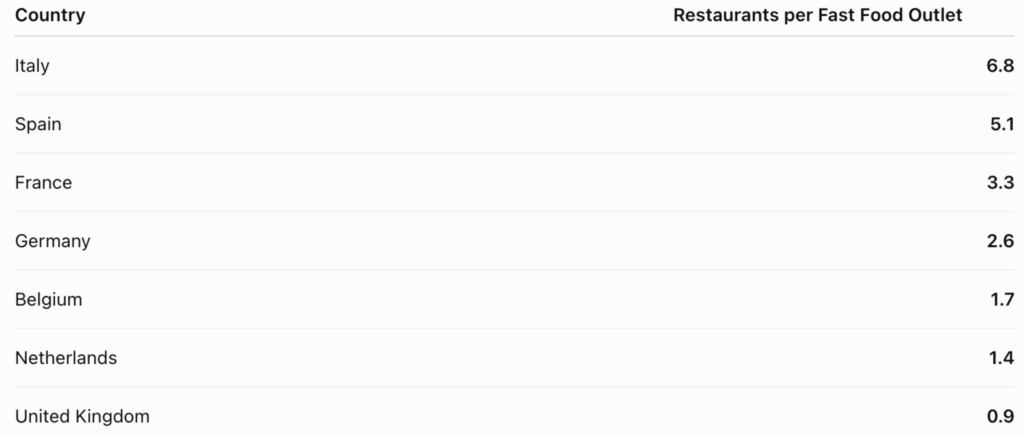
This analysis highlights the existence of two broad consumption models across Europe.
On the one hand, Mediterranean countries such as Italy and Spain, where traditional restaurants remain overwhelmingly dominant and form an important part of cultural identity. On the other hand, countries in North-Western Europe, where fast food occupies a much more significant position within consumer habits.
Despite these structural differences, one conclusion stands out: since 2023, most European markets have entered a period of contraction affecting both traditional restaurants and fast-food outlets. Fast food, however, appears to be generally more resilient, suggesting a gradual shift in consumer behaviour and spending priorities across Europe.