
- Insights
The Rise of Alcohol-Free in Dutch Hospitality: Trend or Transition?

As the terrace season slowly comes to an end and the Dutch hospitality industry looks back on the summer, entrepreneurs are increasingly noticing a trend in alcohol consumption. Traditionally, the Netherlands has a culture where alcohol consumption plays a major role in hospitality. In recent years, however, a growing group of consumers has been opting for health and making more conscious financial choices: Generation Z (born between 1997 and 2012).
Where previous generations saw the pub as a social hotspot and beer flowed freely, Gen Z is increasingly choosing an alcohol-free or healthier alternative, and visiting pubs less often. Why is this happening, and what does the data tell us?
Alcohol Consumption Among Young People is Declining
– In 2024, 72.4% of 12- to 16-year-olds reported never having consumed alcohol. Among 16- to 20-year-olds, 28.9% said they had never drunk alcohol, an increase compared to 2023. (Source: NJI)
– The percentage of young people who engage in heavy drinking (≥6 drinks per occasion for boys, ≥4 for girls) dropped from 25.5% in 2023 to 17.5% in 2024. (Source: NJI)
– The trend is also visible among adults: the share of people adhering to the Health Council’s advice (max. 1 drink per day) rose to 45.4% in 2024. (Source: Trimbos)
Why?
– Health & Well-being: Young people, in particular, are more conscious of mental and physical health. While alcohol remains socially accepted in the Netherlands and is still consumed regularly, awareness of its long-term health risks is growing. As a result, alcohol is increasingly skipped or replaced with a healthier alternative.
– Financial Pressure and Inflation: Consumer prices have risen significantly in recent years, including the cost of alcoholic beverages in hospitality. This makes a night out at the pub less affordable for many.
(Source: Time)
What Does Our Data Show?
Our data confirms these developments. When we look at the evolution of the bar/café and club/nightclub segments, we see a clear downward trend in the number of active locations in the Netherlands:
Both in the Bar/Café and Discotheque/Nightclub segments, there is a noticeable decline in the number of active locations.
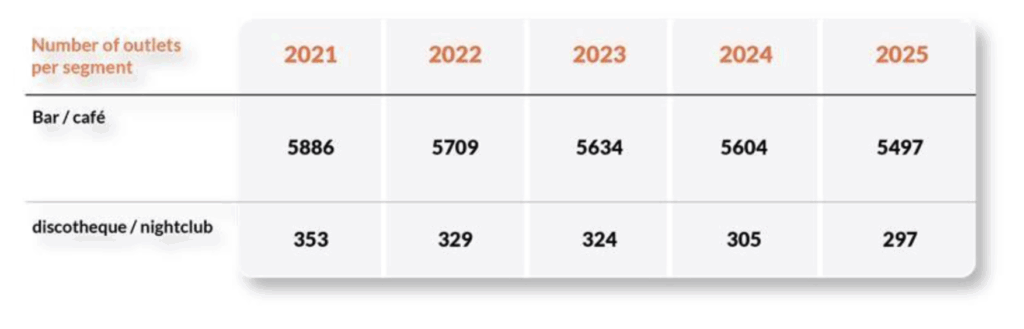
(Source: Roamler)
How Can the Average Hospitality Entrepreneur Respond to This Trend?
These developments are not the most positive sign for the average pub owner, and the declining popularity of alcohol among young people is unlikely to reverse anytime soon. Nevertheless, this also presents opportunities:
– Research shows that hospitality businesses can increase their beverage revenue by 16% by offering a better range of alcohol-free and low-alcohol options. This represents a potential additional revenue of €437 million. (Source: Baaz)
By offering an extensive range of these types of beers, you can ensure that this consumer group still has plenty of choices and keep them coming to your venue.
In addition, there is a growing popularity of beer substitutes such as so-called hard seltzers. These are soda-like alcoholic drinks that contain fewer calories than beer and therefore fit better into a healthier lifestyle. In the Netherlands, brands like Stëlz and Gig are on the rise.
In 2024, this market reached a size of $7.9 billion globally, and it is expected to grow to over $20 billion by 2033. (Source: Vocal Media)
Conclusion
The decline in alcohol consumption among Gen Z is not a threat but an opportunity. Hospitality entrepreneurs who invest now in alcohol-free experiences and healthy alternatives will attract not only young people but also a broader group of health-conscious consumers.
Want to know how your venue scores on the availability and presentation of alcohol-free drinks? With Roamler, you can:
– Scan menus to gain insight into your 0.0 offering via our Word Search.
– Gain insights into the effectiveness of promotions in the OOH channel through our Roamler crowd.
– Map the entire hospitality market using our location database.