
- Insights
What is Sales Force Automation (SFA) in Out-of-Home? Definition, Benefits & How Brands Use It

Definition: What is Sales Force Automation (SFA) in Out-of-Home?
Sales Force Automation (SFA) in out-of-home refers to the use of digital tools to structure, optimise, and track the activity of field sales teams operating in the HoReCa channel, enabling them to prospect new outlets, manage existing accounts, capture in-field data, and execute brand standards across a highly fragmented market.
While SFA in Retail focuses primarily on shelf compliance, planogram verification, and order capture in structured store networks, OOH SFA addresses a fundamentally different set of challenges:
• Mapping and prospecting a constantly evolving outlet universe
• Managing distribution activation outlet by outlet
• Capturing outlet-level data (product range, serving standards, competitive presence) in real time
• Coordinating field teams across geographies with no fixed route structure
• Tracking the commercial development of each outlet over time
In the HoReCa context, SFA is the system that makes a fragmented, data-poor market legible and actionable for a brand’s commercial organisation.
Why is SFA a strategic tool for OOH Field Teams?
🗺️ The market is too fragmented to manage manually. A beverage brand operating across a country is potentially targeting thousands of individual outlets. Managing prospecting, visit scheduling, account development, and performance tracking for that universe with spreadsheets and phone creates significant operational complexity.
📊 Data capture is the competitive advantage. In retail, brands can rely on panel data, EPOS feeds, and retailer databases to understand what is happening in the market. In HoReCa, almost none of these sources exist at outlet level. The only way to build a reliable picture of distribution, execution quality, and competitive activity in the on-trade is through systematic field data capture. SFA is the infrastructure that makes this possible at scale.
🎯 Visit prioritisation determines commercial outcomes. Without SFA, field reps visit the outlets they know: their existing accounts, the ones nearest to the previous visit, the ones that are easiest to get into. With SFA connected to an outlet database and commercial performance data, visits are directed to where they will have the greatest impact: high-potential white space outlets, accounts showing distribution gaps, or locations where a competitor has recently activated.
⚡ Speed of activation matters. In the on-trade, being the first brand to activate a new outlet (a newly opened coffee shop, a recently refurbished bar) creates a distribution position that is difficult for competitors to displace. SFA that flags new outlet openings in real time and routes them to the nearest available rep is an activation advantage.
💡 Plan, visit and activate more outlets with Salesmapp
Salesmapp is the SFA platform built specifically for OOH field teams: combining a live database of 3M+ European HoReCa outlets with intelligent visit planning, structured in-field data capture, and real-time performance tracking.
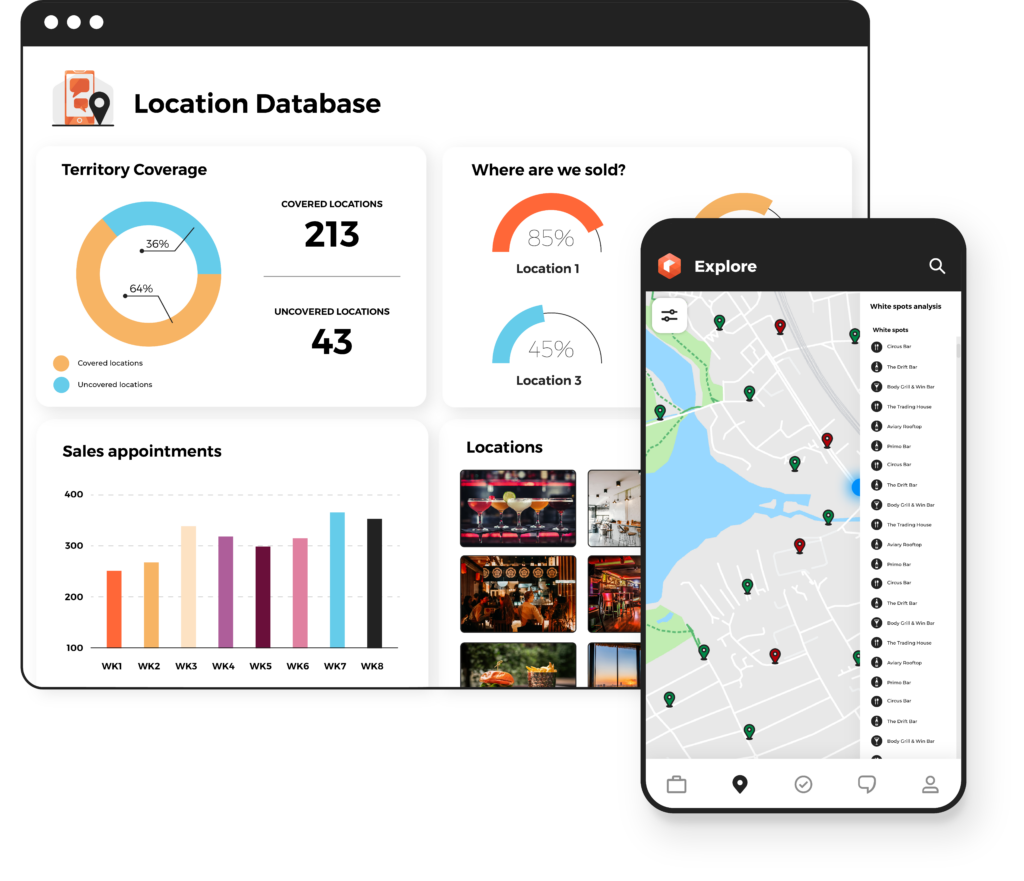
Some key features of an OOH SFA Platform
• Outlet database integration. The foundation of effective OOH SFA is a live, accurate outlet database, covering outlet type, location, status (open/closed/new), ownership, and commercial characteristics.
• Intelligent visit planning and routing. Field reps receive a daily visit schedule based on commercial priorities: new outlet, accounts to follow-up, outlets flagged for competitive activity. Route optimisation minimises travel time and maximises productive visits per day.
• Structured in-outlet task execution. At each outlet, the rep follows a guided workflow: recording which products are listed, verifying serving standards, capturing competitive presence, noting outlet characteristics… Structured capture ensures consistency across the entire team, and makes the data comparable across markets and time periods.
• Photo capture and verification. Photos of product placement, serving conditions, and outlet environment are captured during each visit, creating a verifiable evidence base for commercial decisions and brand compliance monitoring.
• Real-time performance dashboards. Sales managers see field team activity, visit completion, outlet development metrics, and distribution gains in real time, without waiting for weekly reports. Alerts flag priority situations requiring immediate attention.
Discover Salesmapp, our all-in-one Field Sales App
Contact us to know more!

Some frequently asked questions
In HoReCa, the distinction between SFA and CRM is more pronounced than in retail. CRM (Customer Relationship Management) focuses on managing ongoing commercial relationships: tracking contact history, agreements, and account value for existing customers. SFA focuses on the field execution layer: visit scheduling, in-outlet task completion, data capture, and distribution tracking. For HoReCa field teams, SFA is the more operationally critical tool. The market is too fragmented and too dynamic for relationship management alone to drive results. The most effective commercial organisations use both: SFA for field execution intelligence, CRM for account management and pipeline tracking.
Prospecting in HoReCa is a data problem. Without a live outlet database, field teams prospect based on what they know: their existing territory, outlets they’ve visited before, recommendations from existing accounts. This systematically underestimates the white space opportunity. OOH SFA platforms like Salesmapp, built on a live outlet database, give field teams a complete and current map of all outlets in their territory, filtered by type, size, location, and commercial characteristics. This transforms prospecting into a process: identify the highest-potential uncovered outlets, route the team to them, and track activation in real time.
Yes, and for small teams, the impact is often proportionally higher. A small field team without SFA spends a disproportionate amount of time on administrative tasks, suboptimal routing, and reactive visiting. SFA eliminates this overhead and ensures every visit is directed to where it will generate the most commercial return.
This is one of the most important questions for any HoReCa SFA implementation, and one of the most common failure points of static directory-based approaches. Roamler’s Location Database is continuously updated, which mean field teams are always working from a current outlet map, not a database that was accurate eighteen months ago. In a market where new coffee shops open weekly and bars close monthly, the currency of the outlet data is as important as its coverage.