European hospitality had a hard 2023. What does 2024 look like so far? Are some segments pulling ahead while others struggle, and how do the markets compare against each other?
We look at four segments — fast casual restaurants, social dining restaurants, bars and cafés, and coffee bars — across five markets: the Netherlands, Belgium, Germany, France and the UK.
Note on the figures: these are mid-year 2024 readings against full-year 2023, taken from our Foodservice Database in July 2024. Percentages are rounded to the nearest whole point.
Fast Casual Restaurants
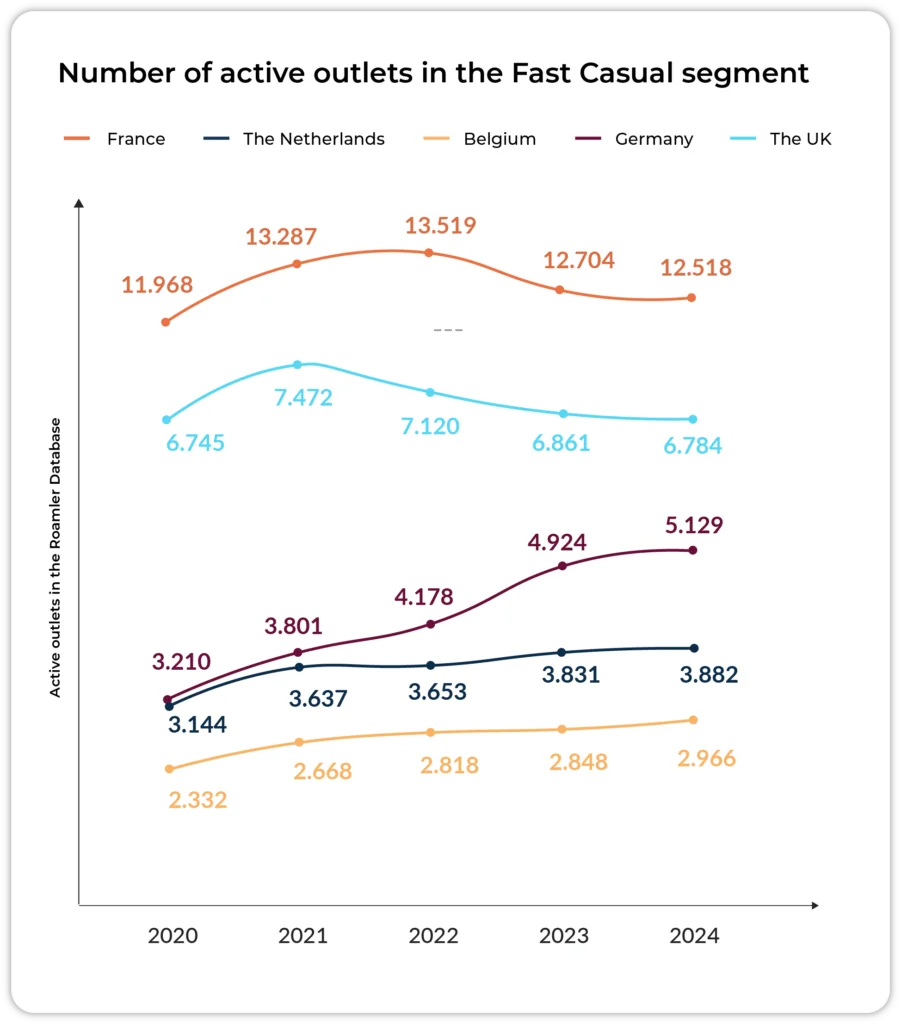
Fast casual has held up across most European markets, though the pace varies a lot.
In the Netherlands, the segment is up 1% on 2023. As we noted in a previous article, fast casual kept growing while most other eat, drink and sleep segments declined. That growth is worth watching, though: it was +5% in 2023 against +1% now, which is a marked slowdown rather than a continuation.
Belgium and Germany are both up 4%, holding their ground against the same market pressures. France and the UK are each down 1% — but both were falling far faster a year ago, at −6% and −4% respectively, so the trajectory points towards stabilisation rather than further decline.
Social Dining Restaurants
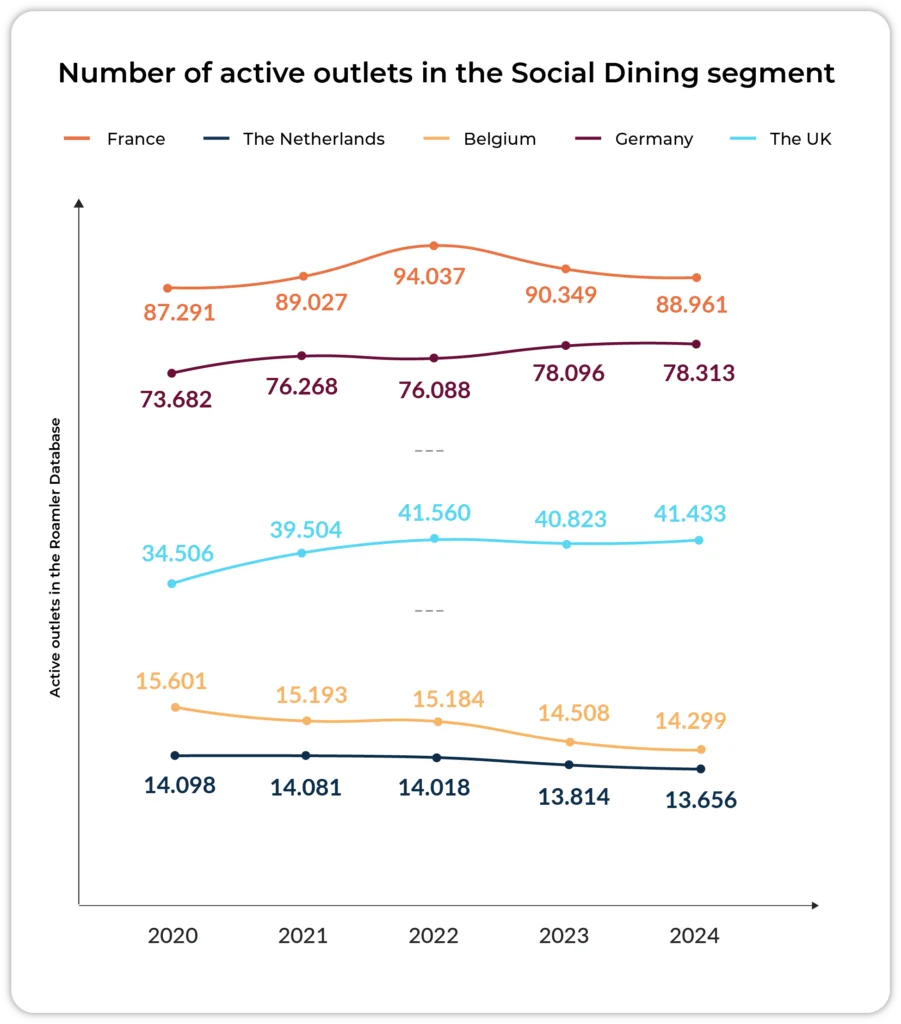
Social dining is the most uneven of the four segments.
The Netherlands is down 1%. The segment has been flat since 2020 and falling since 2023, driven by closures rather than by insolvencies — venues leaving the market by choice rather than by failure, which is a different problem for brands trying to hold distribution.
Belgium is also down 1%, but after −3% in 2021 and −4% in 2023, the rate of decline is easing.
France ran against the trend for several years, up 2% in 2021 and 6% in 2022, and has since given much of it back — a combined 6% drop across 2023 and 2024. Germany and the UK are the two markets in positive territory, though Germany's gain is slight enough to round to zero, and the UK's 1% follows a −2% year, which makes it a recovery rather than an expansion.
Bars and Cafés
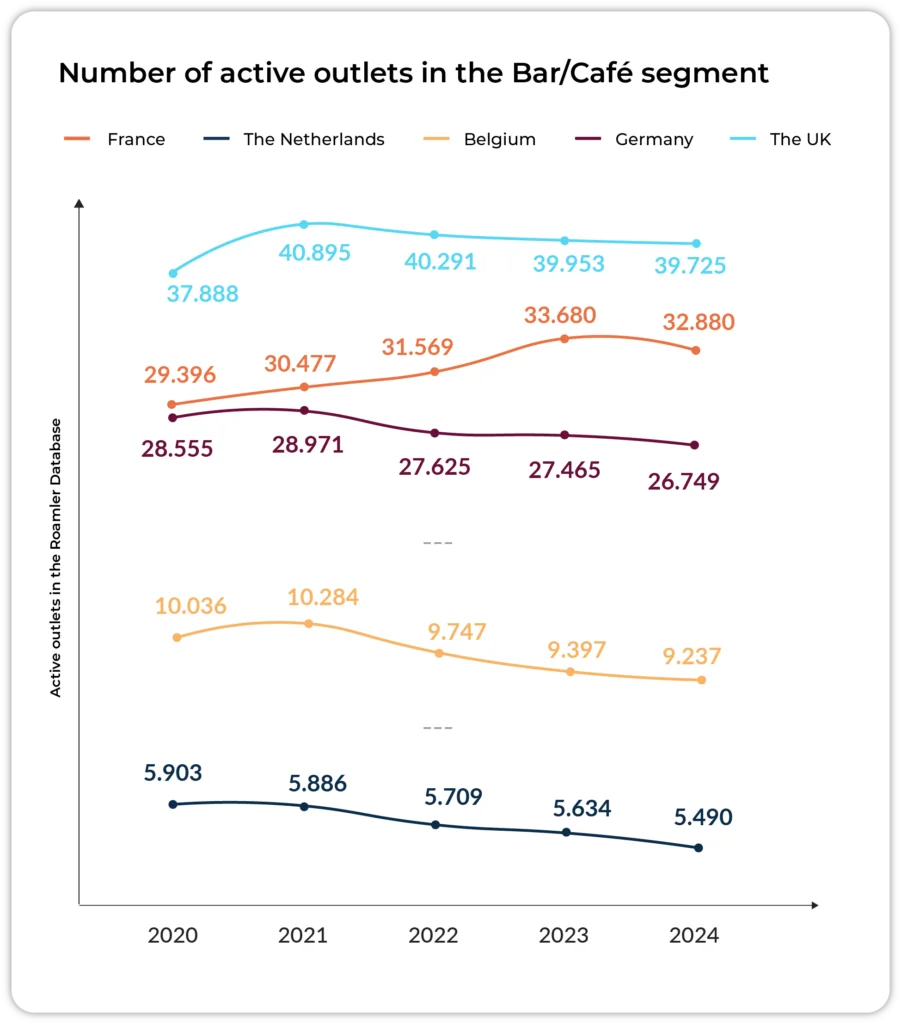
This is the segment in the clearest difficulty: every market analysed is down.
The Netherlands and Germany both fell 3%, France 2%, and the UK 1%. Belgium is the one qualified positive — after −5% in 2022 and −4% in 2023, this year's 2% decline represents a slowdown, if not yet a floor.
Coffee Bars
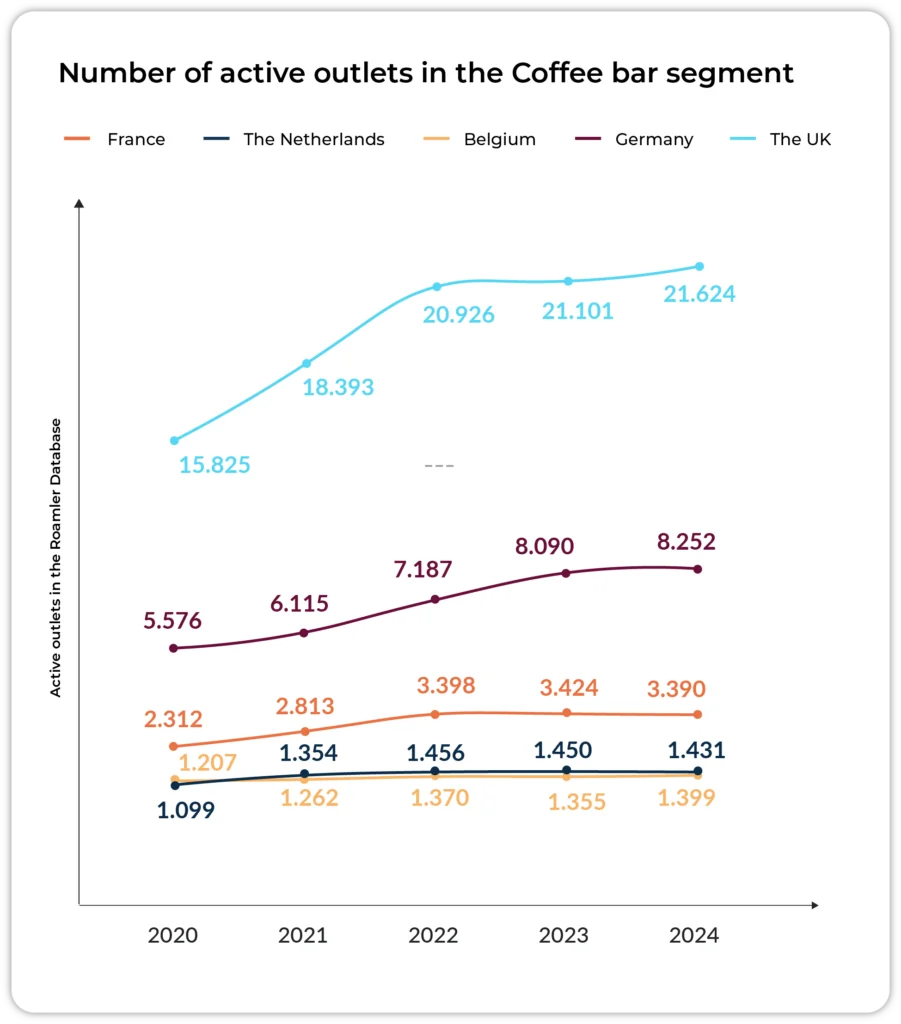
France and the Netherlands follow the same shape: strong growth through recent years, then a turn downward in 2024, with both markets off 1%. Whether that signals saturation is the open question — it is too early to call from a single year, and it is the segment most worth watching through the coming months.
Germany and the UK are still growing, both up 2%, but the deceleration is just as visible there. Germany posted an 18% increase in 2022; 2% is a different market.
Conclusion
European hospitality is still recovering unevenly. Bars and cafés are declining in every market covered, without exception. Fast casual is the growth story in the Netherlands, Belgium and Germany, and social dining has returned to modest growth in the UK.
What runs through all four segments is deceleration: the markets that are growing are growing more slowly than they were, and the markets that are falling are falling more slowly too. That makes current location data more valuable than a trend line, because a segment can turn inside a single year — and a rep sent to an outlet that closed last quarter is a visit paid for twice.
Unlock Your Growth Potential With Our Foodservice Database
Location-level detail across 30+ attributes, updated continuously — so your field team works from the market as it is, not as it was.
Discover the Foodservice Database