Dining habits and restaurant culture vary widely across Europe, each market carrying its own traditions. This article looks at how restaurant types are evolving, which cuisines dominate where, and which meals restaurants actually build their service around.
The two restaurant types in our database
Fast casual. Sits between fast food and casual dining: limited or self-service, high table turnover, lower price point, and a focused or themed menu — pancakes, pasta, and so on.
Social dining. Full service, extensive menu, and a higher price point than fast casual.
The European Restaurant Landscape
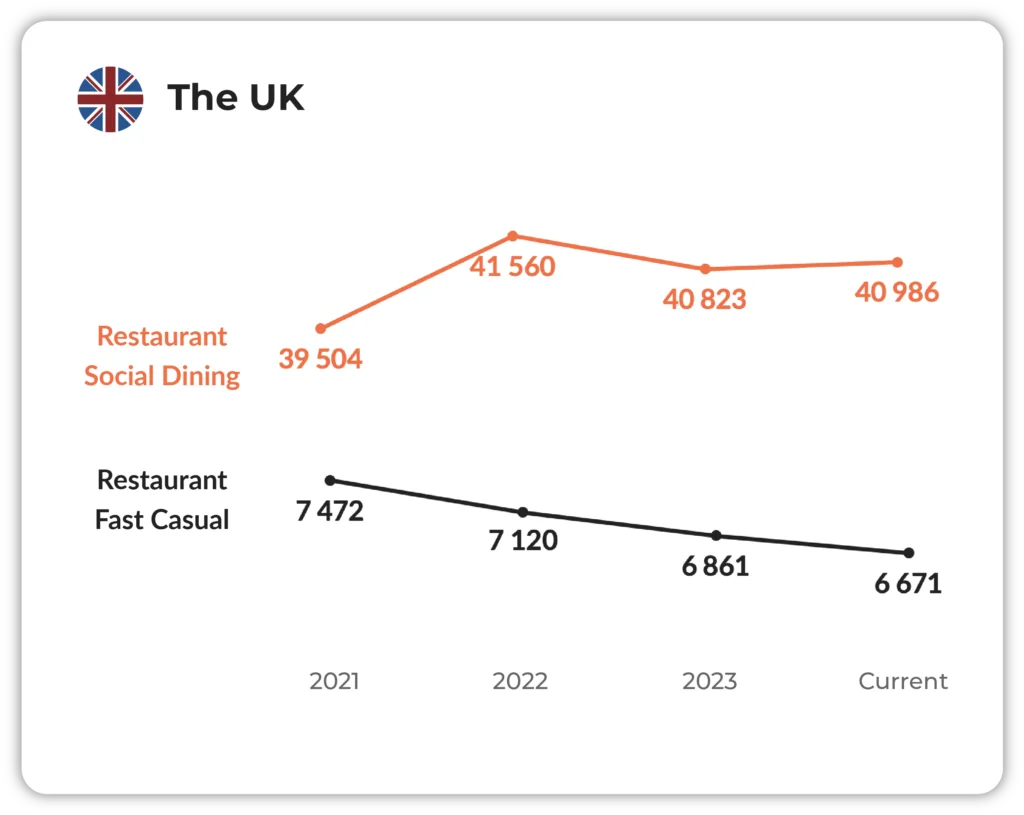
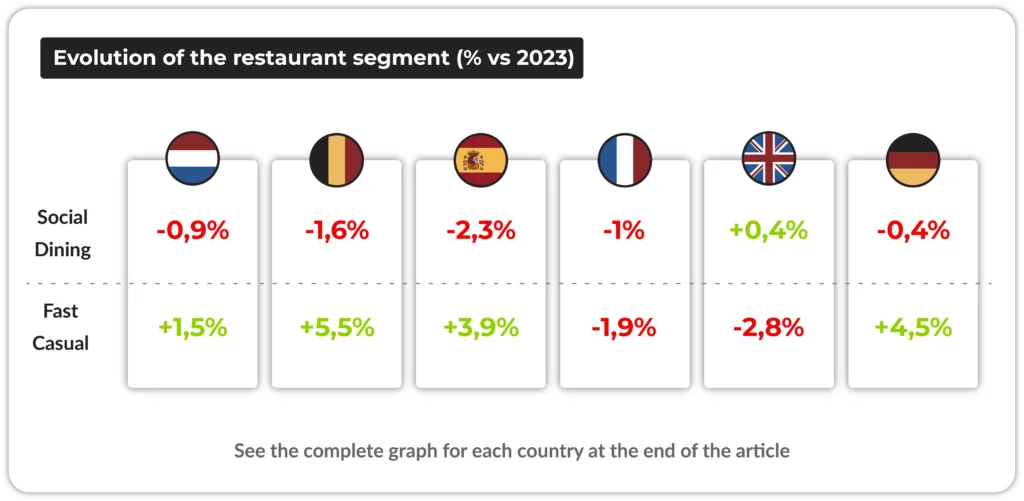
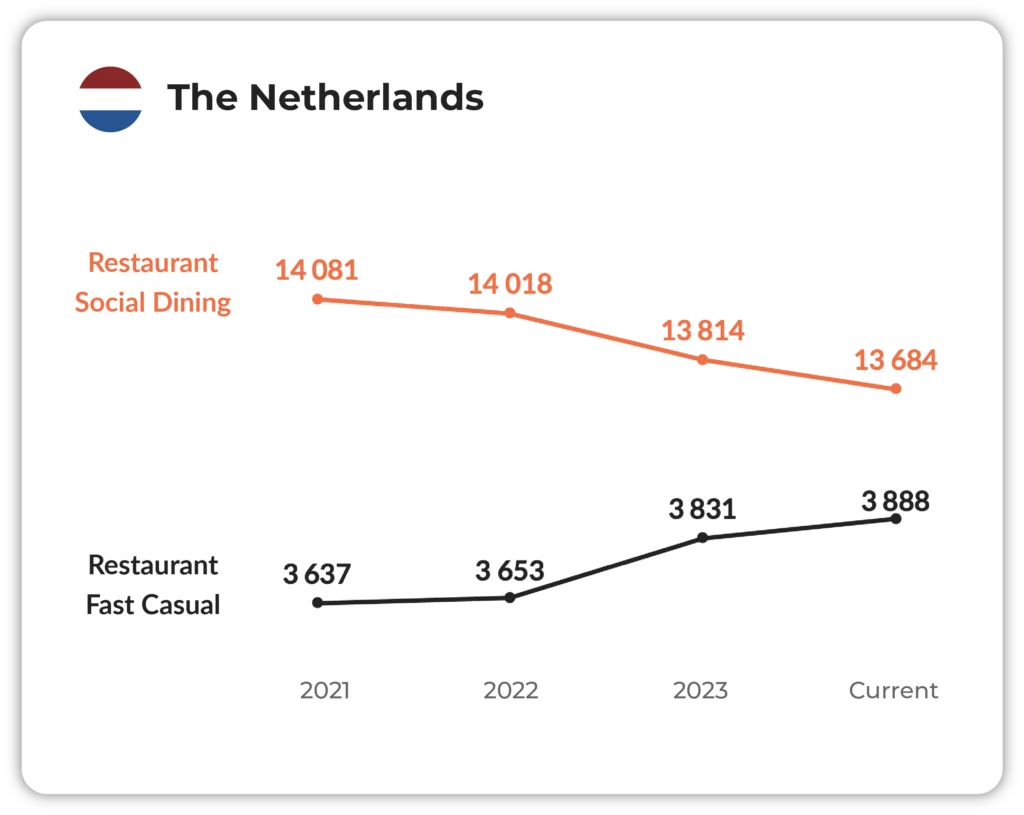
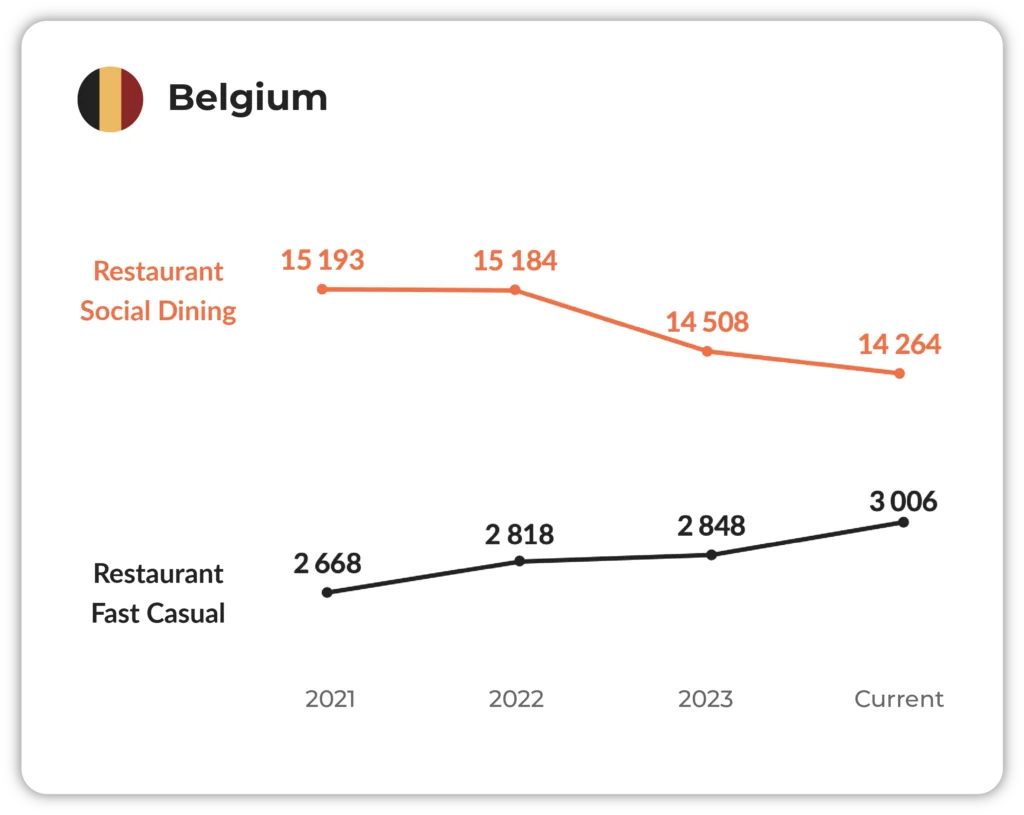
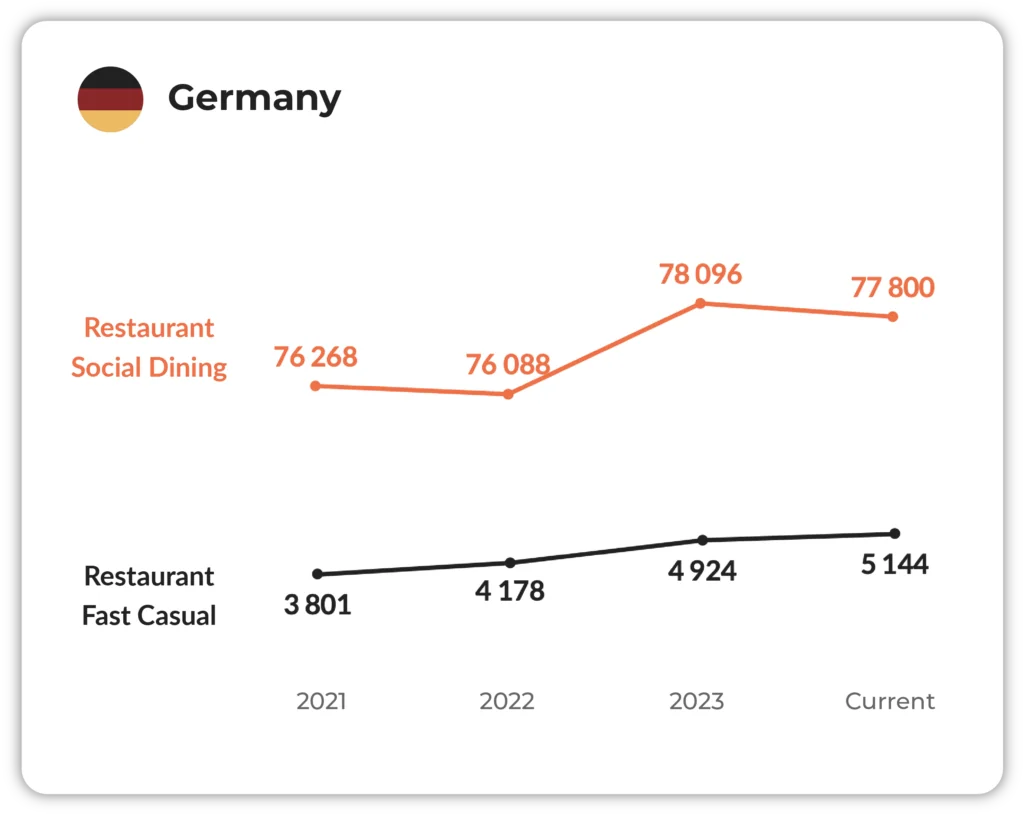
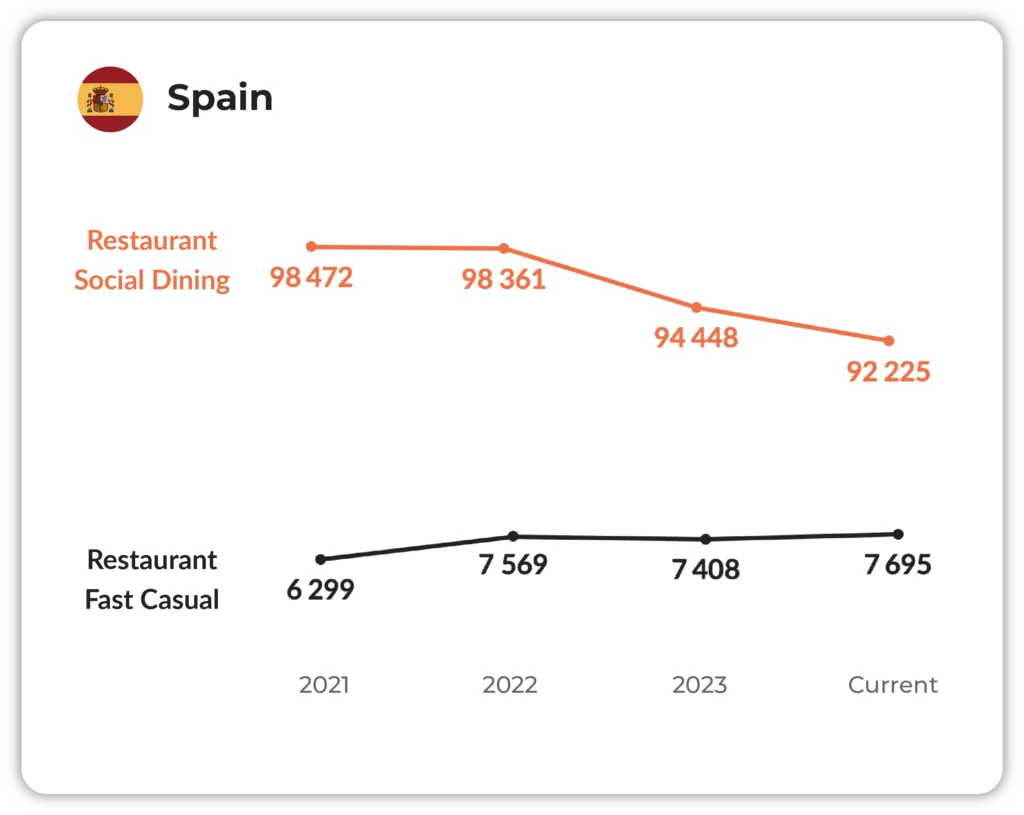
The figures below compare 2024 against 2023 across six markets. Country-level charts covering 2021 to 2024 are at the end of the article.
Social Dining Is Under Pressure Almost Everywhere
As we noted in a previous article, social dining has had a difficult year, and the pattern holds across most of Europe.
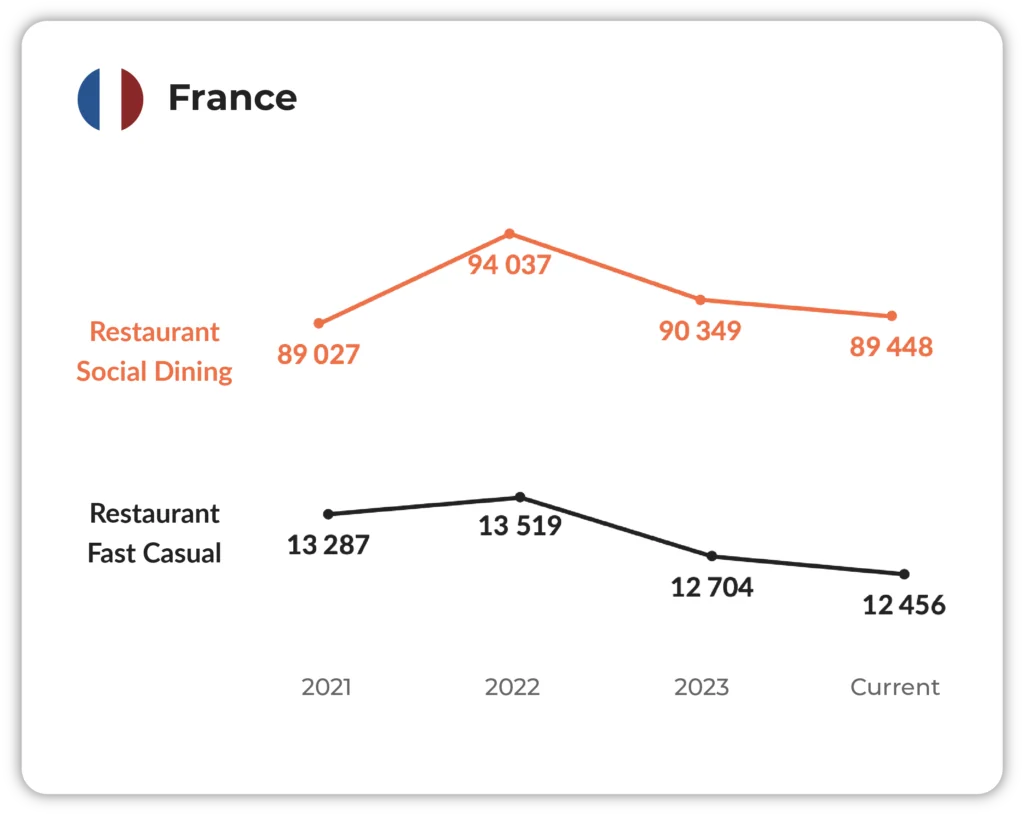
Against 2023, numbers are down in most markets, with Spain falling furthest at −1.6%. Belgium and France also contracted. The driver is straightforward: inflation and financial uncertainty have made people more careful with discretionary spending, and higher-priced dining is the first thing they cut.
The UK is the one exception, up 0.4%. That is a slim margin, and it suggests stability rather than genuine growth — the kind of position that could reverse if economic pressure persists.
Fast Casual Keeps Growing
Fast casual has proved more resilient. France (−1.9%) and the UK (−2.8%) both declined in 2024, but elsewhere the segment expanded — Belgium up 5.5%, Germany up 4.5%, Spain up 3.9%.
That reflects a shift towards eating out that is convenient, affordable, and quick, without giving up on quality. Where consumers are trading down from social dining, fast casual is where a good part of that spend lands.
National and Plant-Based Cuisines
How we calculated this
Every restaurant in our Foodservice Database carries a kitchen type label, which makes it straightforward to identify the most frequent kitchen type in each country. Request a demo to explore it yourself.
Culinary tradition still shapes the landscape. In France, Belgium and Spain, more than 20% of restaurants serve a fully national cuisine — a strong attachment to local food culture that has not weakened.
Vegetarian offerings are the other force at work. They rank highest in the Netherlands (18%), the UK (15.9%) and Germany (14.9%), and the shift shows up in both restaurant types as consumers look for healthier and more sustainable options. In the UK, multiculturalism adds another layer: Indian cuisine ranks third, broadening what both fast casual and social dining venues put on the menu.
Which Meal a Restaurant Is Built Around
Meal preferences differ across Europe, and restaurants organise their service accordingly.
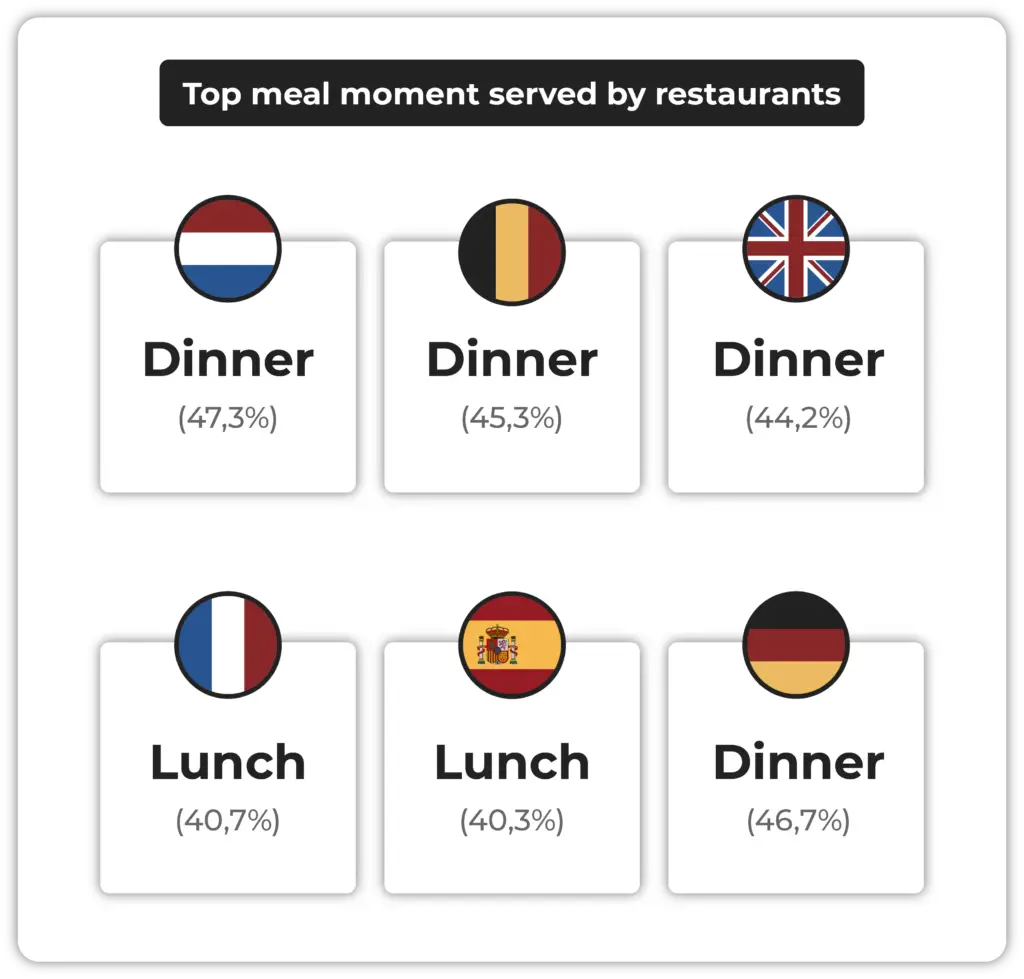
In the Netherlands and Germany, dinner dominates: 47.3% of Dutch restaurants and 46.7% of German ones serve it, and evening service is what most of them are built around.
France and Spain lean towards lunch, at 40.7% and 40.3% of restaurants respectively. The long lunch break remains a cultural fixture, and it shapes how service is scheduled across the day.
Breakfast is the clearest split of the three: served by around 22% of restaurants in southern Europe against roughly 13% further north.
Conclusion
The split between fast casual and social dining tracks the economic climate closely. Fast casual is rising on demand for convenience, affordability and flexibility. Social dining is struggling wherever a higher price point has become harder to justify.
Local culinary tradition and the growth of plant-based eating will keep shaping both. Fast casual is well placed to absorb those changes, combining speed with the quality consumers now expect. Social dining will need to work harder on what it offers beyond the meal itself.
Discover the Full Potential of Your Market
Our Foodservice Database maps 4M+ European Foodservice outlets by type, cuisine, meal service and more — updated continuously.
Discover the Foodservice DatabaseAppendix: Country Detail, 2021–2024
Evolution of both restaurant segments in each of the six markets covered above.
Netherlands
Belgium
Germany
Spain
France
United Kingdom