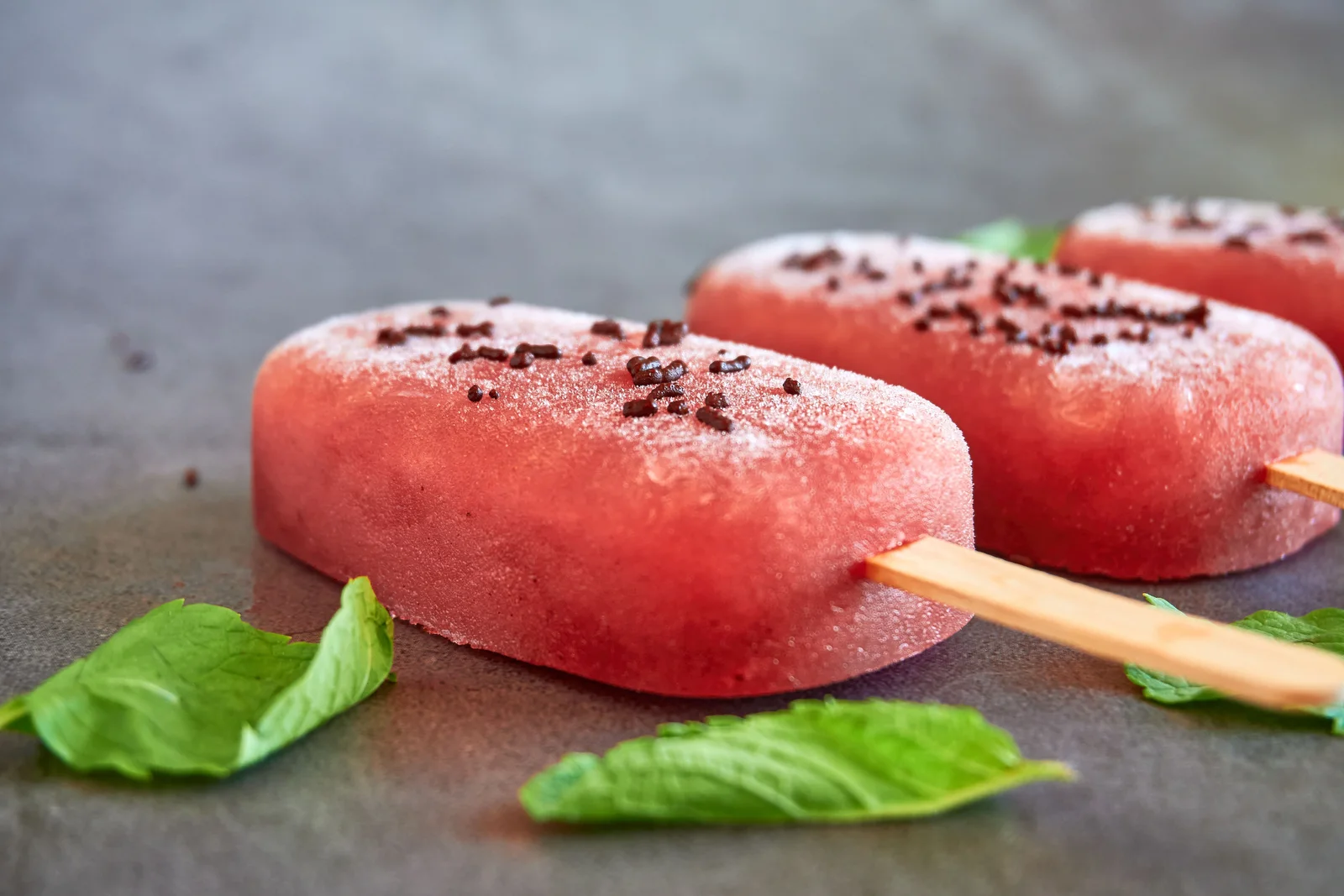
Ice cream is one of the most widely consumed categories in Europe — and one where brand loyalty is weaker than the marketing spend behind it would suggest. What shoppers say drives their choice is flavour, by a very wide margin.
How we collected the data: 5,357 respondents across Italy, Spain, the United Kingdom, Belgium, the Netherlands and Germany, surveyed through our community in July 2019.
Almost Everyone, in Almost Every Format
96% of respondents eat ice cream. Format preferences overlap heavily — most people buy more than one type.
Preferred formats. Multiple answers possible, so shares do not total 100%. Base: 5,357 respondents, July 2019.
National differences are pronounced enough to change a range plan. Italy leads on cones (70%). Belgium skews heavily to tubs (67%) and away from cream-based sticks (23%). The Netherlands is the outlier on water-based lollies (57%) and lowest on sandwiches (12%).
A Summer Category — Except in the North
Consumption is seasonal, as expected: most Europeans eat ice cream regularly in spring and summer, and only occasionally in autumn and winter.
The interesting part is who ignores the season. 93% in the UK and 92% in Germany still eat ice cream during the colder months. Spain is at the other extreme, with the largest share of people who stop entirely once the weather turns.
For a manufacturer, that flips the usual assumption about where winter volume comes from. The warmest markets are the most seasonal; the cooler ones sustain year-round demand.
Refreshment First, Reward Second
The two leading motives are close enough to be treated as equally weighted propositions rather than a primary and a secondary one — and they call for different messaging, formats and moments.
Reasons for eating ice cream. Multiple answers possible. Base: 5,357 respondents.
Among the 4% who do not eat ice cream at all, the reasons split roughly between not liking it, avoiding dairy, considering it unhealthy, and dieting. That subgroup is around 200 respondents, so treat the breakdown as indicative rather than precise.
Flavour Decides, Not Brand
This is the finding worth building a category strategy on: flavour at 86% against brand at 27%, a gap of nearly sixty points.
Most important factors in the purchase decision. Multiple answers possible. Base: 5,357 respondents.
The same pattern appears in how shoppers move between premium and private label. Only 13% buy private label exclusively, 37% buy premium only, and half the market buys both.
Premium versus private label behaviour in the supermarket. Base: 5,357 respondents.
And what makes that half cross the tier is, again, the flavour.
Why shoppers buy across both tiers. Multiple answers possible. Base: shoppers buying both tiers.
Put together, the reading is that half the market is not brand-loyal but flavour-loyal, and will cross the price tier for the variant it wants. For a manufacturer, that argues for range breadth and new flavour development over brand equity spend — and it means a delisted or out-of-stock variant does not convert into a sale of another line in the same brand.
Promotional sensitivity varies enormously by market: 68% in the UK say promotions influence their ice cream purchase, against 9% in Germany and a European average of 46%. Italy is the least price-driven market (36% cite price against 56% overall) and the most ingredient-driven (42% against 23%).
Two Channels, Two Behaviours
Purchasing splits between the supermarket, on-the-go, and both.
Purchase channel. Base: 5,357 respondents.
Within the supermarket, volume divides evenly between multipacks and scoopable tubs — both from the freezer — with a further slice bought as single items from the impulse cooler. Dutch shoppers over-index on multipacks (62% against 42%).
What is bought in the supermarket — 85% of it from the freezer, split evenly between multipacks and tubs. Shares total 99% in the source data. Base: 5,357 respondents.
On-the-go is where impulse dominates: nearly half describe it as a spontaneous purchase.
On-the-go purchase planning. Base: 5,357 respondents.
Destinations are led by the dedicated ice cream shop (56%), then the supermarket (21%), bars and kiosks (8%), petrol stations (5%) and convenience stores (4%).
Two national exceptions matter for distribution. Italy (89%) and Germany (72%) buy on-the-go almost entirely through ice cream shops. The UK is the only market where convenience carries real weight (19% against 4% elsewhere), and Spain routes on-the-go purchases through supermarkets (40%).
What This Means in Store
- Protect the flavour range, not just the brand block. With half the market switching tiers on flavour, an out-of-stock variant is a lost sale rather than a switch within your portfolio.
- The freezer and the impulse cooler are different jobs. Planned multipack and tub purchases sit in one; 15% of volume and most of the impulse sits in the other.
- Match promotion to market. 68% promotional sensitivity in the UK against 9% in Germany is not a difference of degree.
- Winter volume comes from the north. The UK and Germany sustain consumption through the colder months; Spain does not.
Check Your Range in the Freezer and the Impulse Cooler
Our community reports on which variants are actually on shelf, in which cabinet, at which price — with photographs from every store visited.
Discover In-store insights