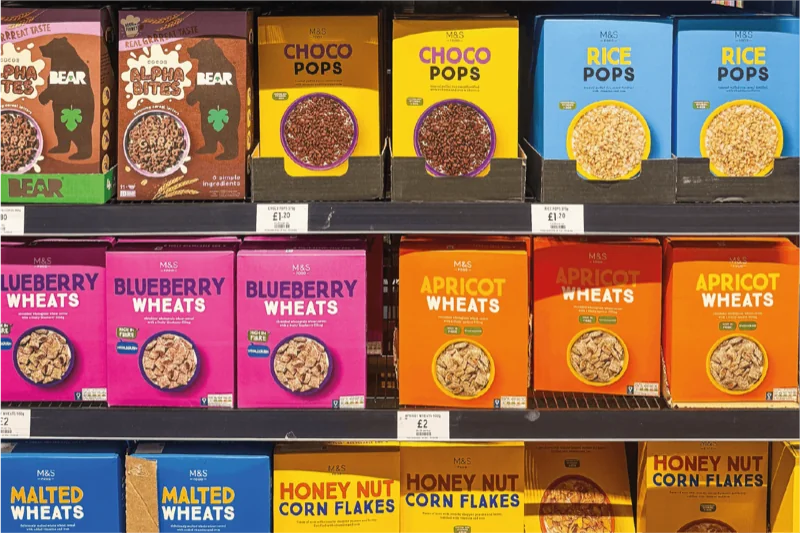
Private label looks nothing like it did ten years ago. What started as a budget alternative — plain packaging, lower price — has quietly become a full brand portfolio. From premium ranges to themed sub-brands, most shoppers now barely notice where the retailer ends and the brand begins.
In this article, we look at how six major UK retailers have built their portfolios, to help you better understand these increasingly influential competitors.
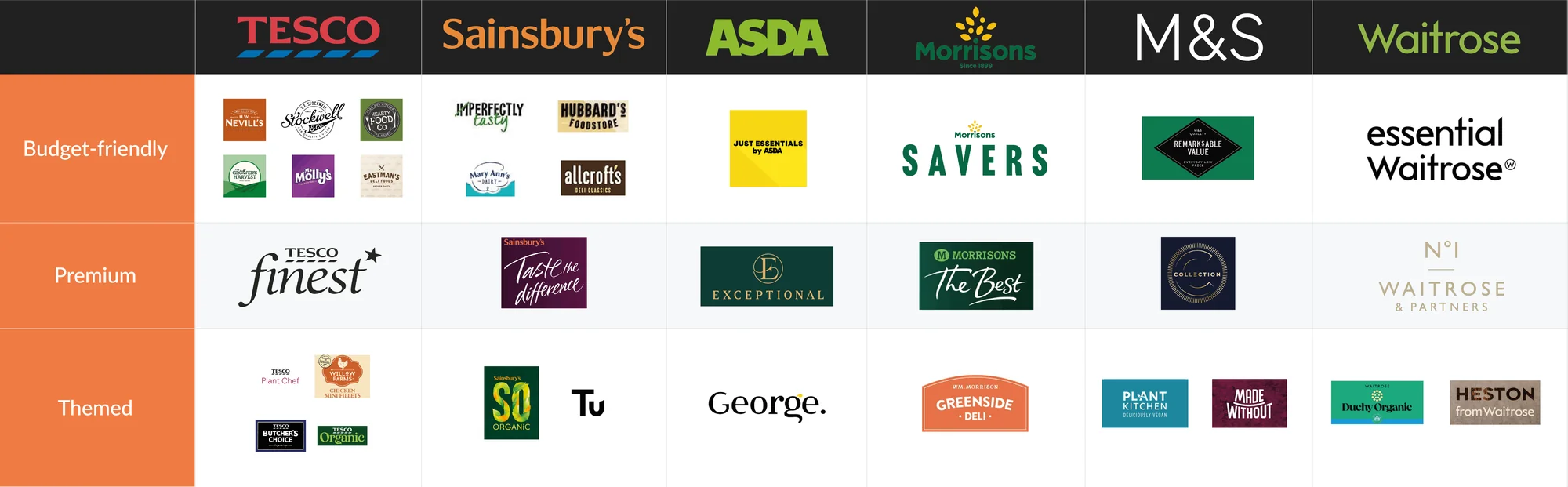
A Closer Look at Each Retailer
All six retailers now operate across budget, standard and premium tiers. Here are some interesting facts about each one.
- Tesco — removed their logo from packaging and created sub-brands that look like real brands (Stockwell & Co., Hearty Food Co., H.W. Nevill's, Grower's Harvest, Ms Molly's, Eastman's…).
- Sainsbury's — focused on the premium range with "Taste the Difference" (1,200 products across 11 categories) that competes with branded products on quality.
- Asda — built brands at both ends: budget (Just Essentials, a 300+ line range launched in 2022) and premium (Exceptional by Asda, launched in 2024).
- Morrisons — manufactures its own products, giving it a cost and quality advantage no other supermarket can replicate. The Best range was extended to over 1,000 products in 2025.
- M&S — until a few years ago, M&S only distributed their own-brand products. They have now opened their shelves to a small proportion of national brands, but own-brand remains dominant. Its Italian Meals range alone grew 35% in sales in 2024.
- Waitrose — a full range from budget to premium (Essentials & No.1), distributing a large majority of private label products, including themed brands such as Duchy Organic, a premium organic brand.
What Does It Mean for Your Brand?
Private label products are becoming increasingly difficult for consumers to identify. Supermarkets have successfully moved away from the traditional "budget" or "low-cost" image by introducing sub-brands that don't always carry the retailer's name.
Private labels also enter the market with several strong advantages. Retailers can buy in bulk, giving them greater control over pricing. They also prioritise their own brands on the shelf — guaranteed placement, faster detection of out-of-stocks, and better overall visibility. In addition, retailers have full oversight of upcoming promotions, allowing them to adapt quickly. For example, if two promotions on crisps are scheduled at the same time, brands may not be aware — but retailers are, and can easily avoid promoting their own products during that period.
With private labels in the race, competition becomes even tougher. To stand out, your store execution needs to be flawless, because theirs will be. Is your agreed shelf space respected? Is your promotion correctly implemented? Is your product well stocked?
Want to monitor your retail execution?
Roamler gives FMCG brands a clear view of what's actually happening at store level across European retailers. Where your agreed space isn't respected or a promotion hasn't been set up, our teams spot it quickly and we make sure the right action is taken before it affects your sales.
Get in touch